Words hold creative power. Genesis tells us the world was created through words.
In the beginning God created the heavens and the earth. The earth was formless and void, and darkness was over the surface of the deep, and the Spirit of God was moving over the surface of the waters. Then God said, “Let there be light”; and there was light.
Genesis goes on to say everything else was created through words, too. Creation was spoken into being. Except for humans - after a conversation within God's self, humans were fashioned, from the earth, and given divine breath.
It occurs to me that breath is used for many things, one of which is to speak. Later, Jesus again reminds us the power our words have. While we may have forgotten the treasure we carry in our lungs, the power is still there, latent.
...if you have faith the size of a mustard seed, you will say to this mountain, 'Move from here to there,' and it will move; and nothing will be impossible to you.
Lately, I've had the opportunity to witness the incredible power of words. A friend recently spoke words of truth and love into a dark place in my life, and indeed, I could suddenly see something new and clear, as if by magic.
Let there be light.
Another scene emerges. One person speaks bitterness and criticism into a room full of people dreaming something new, and working towards a common goal. The whole room deflates like a balloon, and everyone stops. What's the point? The mountain of work seems to disappear, the beautiful vision is obscured.
You will say to this mountain, 'Move from here to there.'
Nothing will be impossible for us, Jesus warns. May we guard our tongues, for we speak with the breath of our creator.
Thursday, April 12, 2012

Monday, April 2, 2012
LA Kills Its Artists

Creativity works best when the artist is relaxed, when the logical brain doesn't sit in the background keeping a close eye on everything, making sure that it shoots a warning flare at anything new and unrecognizable, even if it's just a fancy idea. I like to call this logical brain Babysitter Brain.
In other words, stress is bad for creativity. It forces your creative brain into a constant battle with Babysitter Brain, and trust me. Babysitter Brain usually wins. BABYSITTER BRAIN ALWAYS WINS DAMMIT.
In even more other words, Los Angeles might be the worst place to be if I expect to be an artist of any kind. Because basically, living in this city is like living in a veritable pinball machine of potential hazards - both in a physical visceral sense, and an emotional sense.
Right?
I recently read an essay written by an author who is truly astounded that Los Angeles is not the mecca of nature writing because it's bursting with the fecundity of nature and life and the interplay between the non-human world and human-built society. I thought hard about this. At first I was like, "Yeah! This author totally hit the nail on the head! Los Angeles is awesome and full of nature and beautiful and there is an ocean here and NATURE WRITERS FOREVAAAAA!" But then I drove like 60 miles in traffic in the next 12 hours and almost got in 4 accidents and 5-6 people rudely honked at me, and I had to beat an angry neighbor back with a stick, and literally step over 3-4 (it's hard to tell sometimes how many are down there) homeless drunk/high/exhausted people passed out on the street, after which I wrote large checks to people clamoring for too much money, and then I was like... "Oh." Yeah. That's why people don't move to LA to write about nature. It's not because LA doesn't have nature or tons of interesting cutting edge environmental movements budding and transforming society as we know it. It's because Los Angeles likes to KILL ITS ARTISTS. Through stress. It's amazing to me that movies get made here, and it really makes me wonder about these successfully creative people. They must already be super rich (and able to buy themselves out of stress, duh), due to that successful screenplay they wrote whilst living a quiet Midwestern town where there is lots of corn growing just outside.
And then I put my hand on my chin and was like, "Ohhhh."
Disclaimer: This post *might* be a little bit of a rant due to some stressful events experienced by the artist in recent weeks and does not necessarily express the opinions of the blog managers.
Tuesday, February 7, 2012
Birthday Suit

I celebrated my thirtieth birthday. I spent several hours with a bunch of women at a Korean spa in Los Angeles. The place is an unassuming building in Koreatown, adjacent to a driveway full of potholes, and valet runners, and homeless men wandering the streets. It’s like many other places in Los Angeles.
Once inside, women of all colors, sizes, and ages mingle in various saunas, hot tubs, cold tubs, and open showers. Some socialize, some are silent. The older (and much wiser) Korean women sit together near a long trough full of warm water, and scrub each other’s backs. They talk without looking at each other, and rub at the same spot on their legs and arms and bellies for forty-five minutes at a time. I wonder if they all know each other or if they just make conversation because they are all here and naked next to each other, and there is not much else to do.
There is protocol. Always shower. After entering a spa, the body sweats, so you have to shower before doing anything else. It keeps the place, and each other, clean and sanitary. When you sit on something, you use a small towel as a barrier. There are women in the corners who call out numbers all day. When your number is called, you get a scrub from head to toe (yes, head to toe and everything in between). I can’t remember ever being this clean – certainly I was not after birth. The whole place reminds me of a tropical river, a constantly flowing stream of warm and cold water, steam and earth smells, and creatures everywhere. The murmur of female voices at first gets lost in the shock of being naked. After settling in, my ears become tuned to all the voices. The voices are all different, like the bodies they inhabit, like the animals along a riverbank. Some are high-pitched and raise at the end of sentences, signaling some mention of playfulness. Some are lower and firmer and stick to the tile and water. Some are hidden voices, requiring many heads to pull in tight, while others sing to the corners of the room without effort. All the sounds, taken together, are like my imagining of a woman’s womb, the place where we are all created and perhaps recreated, where somehow there is enough space to contain the world and especially our own selves.
We all look at each other. We look in curiosity, in fascination, and with no nonsense. We look at each others bodies to see ourselves, perhaps. It is the way a child looks at a grown man and understands that he will one day be just like him, or the way an elder looks at a teenager and remembers when she had crushes on boys. It happens in a moment of humble acceptance – a physical understanding that life is a continuum. In that moment, it's clear that our bodies are stories unfolding, and the imperfections are beautiful. The imperfections are marks of life itself.
It takes me days to process this experience, not because I have to (indeed, it is such a humble and quiet thing that it passes into memory easily and without fanfare), but because it struck something true, and that is worth pursuing. Many have said that we women are uncomfortable with our bodies because society has so sexualized us, and has made us objects. Some say we barely stand to look at ourselves in the mirror because we believe we are not sexy enough, not beautiful enough, not desirable enough. In fact, I don’t think that’s the case, by and large. I don’t believe that every woman wants to be supermodel-beautiful, or wants men to imagine being in bed with her at every glance. Instead, consider this. Do we women believe our bodies are the most fundamental representation of how ‘in control’ we are of ourselves and our lives? We fight to be perfect, to control our calories, to only eat organic, gluten-free, sugar-free, whole-grain, non-gmo foods. We try to starve ourselves to fit an ideal, or we rebel by eating everything we want. When it’s too hard, we give up, then we punish ourselves because we lost control. As our world becomes increasingly chaotic, do we see our bodies as a last bastion of power? If we can shape the details of our bodies, minimize our love handles, and perfectly predict the size of our breasts (and make sure others notice), perhaps we can prove that we are worthy of the goodness in our lives.
Since I’m thirty now, and since I have been naked with women in the spa womb, I can say with confidence that all of that is crazy talk. Controlling every detail of ones body doesn’t mean you have control of your life, and controlling everything doesn’t make anyone worthy of anything except maybe ‘controller of the year’ award. In fact, acceptance – of oneself and others – gets more mileage when it comes to being happy and productive. The fascination of all the flaws in ourselves and others might allow us to see beauty, and give us vision to see what’s important. In the spa the important thing is getting clean. Out here in the world, maybe it is letting go of the distractions, so we are free to take hold of what makes life worth living.
A friend of mine sent me a message wishing me a ‘transformational’ birthday. One thing I can say is this: It was certainly a rite of passage into a new era of embracing the whole story of life, as time moves gloriously forward.
Wednesday, December 28, 2011
Slow Travel

The writer, in the parlor, with the leaky pen. I'm finally allowing the intense quiet of the back woods to feel comforting. I'm about an hour's drive north of Santa Fe, New Mexico, in the Pecos Wilderness, in a cabin, surrounded with snow-footed trees (mostly juniper and piños pine, along with some spruce and elm, our hosts tell us). Deer that are heavier than they appear munch on exposed grasses in the yard, and the ever-charismatic blue jays compete for the bird feeder all day long. Yesterday, upon our first morning waking up in this, the second largest wilderness area in the state, everything seemed a little off. The quiet seemed to boom in my ears, creating a vacuum of sound I've become accustomed to in Los Angeles. I never thought I'd say this, but the constant urban hum can become a part of a person, symbolizing activity that leads to productivity, and a level of security that there is someone out there, even if the occasional loneliness of anonymity hits.
Here, there is no one, except my travel companion and the inn keepers. When the inn keepers leave for an hour, I push away panicked thoughts of potential disastrous emergencies that might occur in their absence. And me without a cell phone signal! Have I become so dependent on the immediacy of living in a city? In these woods, even nearby cabins that are filled with fishermen and campers in the summer have been deserted now, left to stand covered in inches of fallen snow. Their porches are often insurmountable after a storm's hefty deposit that glistens in the sun. In the spring, these flakes will melt and become the drip on the corner of a deck, a drop in the creek, a roar of a river, a molecule in the cell of a tree's xylem pumping water through the trunk to the sky. I walk with a companion, having little to say, our feet crunching on slushy snow along a lane large enough for one car to pass. These seem like the forgotten places for now.
Except, here I am, learning to listen again, learning to hear soft things the way babies do after emerging from a womb that pulsates with the sounds blood rushing around. I am again learning to travel slowly along the path, to see that in the end, this place is more real than our concrete and lifeless structures. In this forest, life springs and falls to a quiet dormancy, and then springs again when the time is right.
After a time, we are surprised to see two men as we round a bend. They are holding cross-country skis. It seems natural to stop and chat, since it may be some time before we see anyone else. Indeed, it seems absurd - rude, even - to not stop and chat. "Any trails you recommend?" One well-groomed gentleman on the verge of old age asks, with a hint of a northern Eurpoean accent that I cannot place. "No, we're just visiting." I reply. "Are you staying around here?" He wonders. "Yup - we are staying down the road, in a bed and breakfast." We wish each other a good trip and move on in silence again.
Somewhere along the path, I am reminded of something I have read many times. Underneath the din of noise, lies the most vital source of life. "Be still and know that I am God." And suddenly, I am...and I do.
Thursday, August 25, 2011
Life, Liberty, and the Pursuit of Ever-Increasing Productivity

A few months ago, I quit my day job as a jack-of-all-trades office worker at a fast-paced internet company in the heart of Los Angeles culture. This was a strategic move on my part. After encountering several enlightening situations, I began to rethink my commitment to a bi-weekly paycheck over my commitment to doing something truly meaningful with my life. I'm not saying working in an office, helping a company run its day-to-day business is not meaningful. In fact, I have come to truly appreciate the very crucial hours people put in to make a small business run (it's a labor of love!), and for some people, this type of work fulfills them. I'm just saying that this type of work is not ultimately meaningful for me, and I finally decided to take a risky jump to fulfill my life purpose. So, with a heart thankful for the opportunity to experience two years in my supporting role, I said a tearful goodbye to my peeps at the office, and have since explored the next step.
So what is the next step?
Report is as follows: I Don't know. Exactly.
Am I allowed to say that? Is an almost-30, educated, smart woman in the prime of life (without children, even!) allowed to say that in our society, which tends to stress 'doing' above 'being'? I know my next step will have something to do with writing, and probably something to do with my interest in environmental issues and urban planning, but those are pretty wide swaths of 'I-don't-know' territory. This is a territory that our American culture has deemed 'A nice place to visit, but wouldn't want to live there,' on par with a hut in the desert, or camping with a dog. According to conventional wisdom, this territory spells disaster if you overstay your visit. Only losers hang out in this no-mans land, people who can't get it together to 'be somebody', those who sacrifice their careers for others, are lazy, homeless, or in jail. It doesn't take long in this position to get the feeling your friends and family are nudging you towards 'official' productivity, demonstrated with carefully-placed comments of "When you get a job..." For normal, nice, hard-working people, the 'I-don't-know' territory should be relegated to one's two weeks of vacation once a year, when God-fearing folks are allowed to wake up in their hotel room and not have an agenda until after they've had their coffee.
For me, every day feels like vacation, for now. Some days are super productive and there are 2000 words on my computer screen and three job applications to show for it, and others are a flop. And I'm not sure how I feel about that, except to say that I made a commitment to myself to not waste another second of my life doing something that isn't contributing to my purpose. For now, this means listening, and looking, and waiting. Is this a little self-serving? Maybe, yes.
On the other hand, if I find the thing - the very important thing that I believe is out there for me to do with my time on earth - it's a very good thing for the rest of the world, because I know it's something that will serve others tremendously. Ultimately, that's what 'finding your purpose' is all about. Not just for me, but for everyone.
Wednesday, August 10, 2011
Let Them Discuss Politics
Living in a large urban city means there are many little interactions that could easily be passed over without much thought. My job as a writer is to be observant of these moments, and to think deeper about them than the average person; I want to bring things that are hidden to the surface in order to see what value they might hold.
One such moment occurred this morning. Waiting in line at Starbucks, I overheard conversation between two Starbucks employees. One woman, busy at the espresso bar making drinks had a sharp (and forced polite) tone in her voice. "You really think that's a correct course of action?" She did not look at the recipient of this comment, but the man next to her, working on an adjacent espresso bar, responded. "Well, sometimes you gotta do what you gotta do. The rioters are just trying to make themselves heard, and now the government is finally listening!" It's clear these two were discussing the riots that are ongoing in London, England. For several days, rioters have been wreaking havoc in this city - one of the main stages of Western civilization.
Their conversation continued. A third employee - a very tall, deep-voiced man, chimed in, "You really think rioting is a good thing? Rioting means no electricity, no gasoline, no food for people!" He shook his head while pouring the drink he was mixing into a cup. He was flabbergasted, and holding back his anger. Outnumbered, the riot sympathizer did not respond. Later, he brought up the topic again, and the woman said with irritation, "I don't want to talk about this anymore. This conversation is going nowhere." The man spoke with disappointment as if to the space between the two employees, "This is the problem - nobody wants to talk about these things, and we need to."
I kept thinking about this last comment. My instinct, and one that many people have when overhearing this type of conversation, is an initial red alert. I have been brought up with the value of politeness (Don't they say to never discuss religion or politics in a social situation?). Furthermore, arguing in front of customers is considered bad service. I could imagine the manager coming over and reminding the three employees that people just want their coffee, not to walk into a cafe full of employees debating an uncomfortable social issue. This idea of customer service - of putting up a pretty face for people even if this means you let go of your personal dignity, is much a product of our post-industrial commercial economy, with an emphasis on providing a 'product' for the public rather than really seeing the business as a part of the real fabric of the community, where real conversations happen. In this economy, even the employee becomes part of the product itself, an objectification of a human.
And yet, isn't this part of the reason that our society is in so much trouble? We have learned, collectively, to turn off the conversation when things get uncomfortable, when things get real. We trade authenticity for productivity. In my travels, I have time and again noticed our unique cultural aversion to discussing 'uncomfortable' topics like politics or religion, whether talking with strangers or close relatives and friends. I've been in considerably less 'open' societies in places like Burma, Latin America, and Samoa, where people are shockingly open to conversations about topics that would make most Americans cringe to discuss openly. I mean, these people are not ashamed of having opinions and they really want to hear mine! And yet, it seems taboo to have these same conversations at a block party in my neighborhood. We seem to relegate these conversations to the personally distant and formal forums of the media. Why?
I don't know why, but lately I've been wishing more people would leave the expectation of mere 'politeness' behind, and start discussing the real stuff. It would be refreshing to talk about that which goes beyond small talk, traffic and weather, and gets down to the core of what makes us human - both individually and collectively. In the end, I agree with the employee this morning. "Nobody wants to talk about these things - and we need to."
One such moment occurred this morning. Waiting in line at Starbucks, I overheard conversation between two Starbucks employees. One woman, busy at the espresso bar making drinks had a sharp (and forced polite) tone in her voice. "You really think that's a correct course of action?" She did not look at the recipient of this comment, but the man next to her, working on an adjacent espresso bar, responded. "Well, sometimes you gotta do what you gotta do. The rioters are just trying to make themselves heard, and now the government is finally listening!" It's clear these two were discussing the riots that are ongoing in London, England. For several days, rioters have been wreaking havoc in this city - one of the main stages of Western civilization.
Their conversation continued. A third employee - a very tall, deep-voiced man, chimed in, "You really think rioting is a good thing? Rioting means no electricity, no gasoline, no food for people!" He shook his head while pouring the drink he was mixing into a cup. He was flabbergasted, and holding back his anger. Outnumbered, the riot sympathizer did not respond. Later, he brought up the topic again, and the woman said with irritation, "I don't want to talk about this anymore. This conversation is going nowhere." The man spoke with disappointment as if to the space between the two employees, "This is the problem - nobody wants to talk about these things, and we need to."
I kept thinking about this last comment. My instinct, and one that many people have when overhearing this type of conversation, is an initial red alert. I have been brought up with the value of politeness (Don't they say to never discuss religion or politics in a social situation?). Furthermore, arguing in front of customers is considered bad service. I could imagine the manager coming over and reminding the three employees that people just want their coffee, not to walk into a cafe full of employees debating an uncomfortable social issue. This idea of customer service - of putting up a pretty face for people even if this means you let go of your personal dignity, is much a product of our post-industrial commercial economy, with an emphasis on providing a 'product' for the public rather than really seeing the business as a part of the real fabric of the community, where real conversations happen. In this economy, even the employee becomes part of the product itself, an objectification of a human.
And yet, isn't this part of the reason that our society is in so much trouble? We have learned, collectively, to turn off the conversation when things get uncomfortable, when things get real. We trade authenticity for productivity. In my travels, I have time and again noticed our unique cultural aversion to discussing 'uncomfortable' topics like politics or religion, whether talking with strangers or close relatives and friends. I've been in considerably less 'open' societies in places like Burma, Latin America, and Samoa, where people are shockingly open to conversations about topics that would make most Americans cringe to discuss openly. I mean, these people are not ashamed of having opinions and they really want to hear mine! And yet, it seems taboo to have these same conversations at a block party in my neighborhood. We seem to relegate these conversations to the personally distant and formal forums of the media. Why?
I don't know why, but lately I've been wishing more people would leave the expectation of mere 'politeness' behind, and start discussing the real stuff. It would be refreshing to talk about that which goes beyond small talk, traffic and weather, and gets down to the core of what makes us human - both individually and collectively. In the end, I agree with the employee this morning. "Nobody wants to talk about these things - and we need to."
Thursday, August 4, 2011
Perfection.
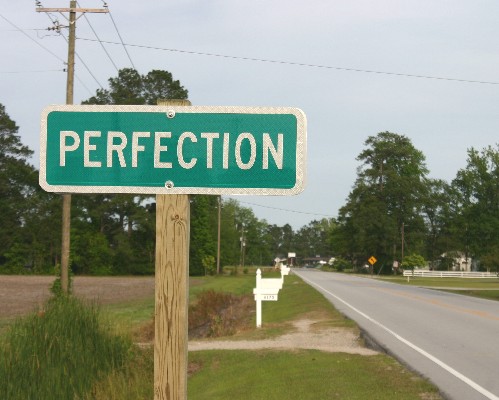
Perfection (n) : freedom from fault or defect
Lately, the issue of perfection has been popping up quite a bit. Every day I struggle with thoughts of guilt that arise from a belief that I am not perfect, and this weighs me down. I wonder sometimes if living in a society where the emphasis is on perfection contributes to this struggle. All around me, images of perfect-looking people abound. Businesses are constantly trying to be more efficient. Industry is always trying to produce more, to make the perfect product, and we all swallow those products in our efforts to achieve our own ultimate perfections. And yet, somehow we never reach the pinnacle. Each time we round the next bend in the road, the top of the mountain gets higher. There are many ways of dealing with the guilt I feel over never being perfect. I trade off self-medicating with these strategies, sometimes using one in high doses and sometimes combining them in a coping cocktail.
a) Ignore it. I tell myself, why think about it? Thinking about it cannot change it. Only doing something to change myself can change the fact that I'm not perfect. I can be more perfect by trying, but only to the extent that i just do it without thinking about it. Don't think about the fact that I don't like not being perfect, just think about the goals, i.e., waking up at 6am every day and jump out of bed without hitting the snooze button. If I did this, I would be more perfect. But if I am not successful, it's ok. Don't think about this missed perfection opportunity. Just do it. Without thinking about it. I feel dizzy.
b) Acknowledge and Try Harder. So what if I'm not perfect? I'm on a journey. At least I'm trying to become perfect, which is more than I can say for that slob over there who doesn't care whether they end up a sad failure and an alcoholic. 'What? No, not you. I'm sure you'll stop being a horrible human being in about a week and a half.' (to myself: yes, you)
c) Accept and Give In. Duh, I'm not perfect. What? Did you not get enough hugs as a kid? Being imperfect is human. Come ooooonnnnn live a little! Don't you dare judge me, you don't know me. I don't judge you. As long as you can keep your mouth shut about how much I suck at this, we can hang out, ok? How dare you try to make me a better person!
So on a day when my mind is clear, something crystalizes: coping methods a, b, and c are completely unhealthy. Coping method a is basically leading nowhere given that I'm not allowed to think or enforce my own goals upon myself. Coping method b makes me a judgemental, hoity-toity b*tch by creating a world in which I constantly use others' downfalls to make myself feel better, and over time I lose many, many friendships. Coping method c breeds a breakdown of relationship with others who might actually have good intentions and see what is good for me in a way that I cannot. These people might actually be wiser than I (gasp!).
Enter spiritual canonball. The other day, all this surfaced as I was reading a passage of scripture. I was reading the New Testament and came across the words of Jesus, reiterated by Paul the Apostle. Paul is speaking to a bunch of non-Jews in Galatia (the area that is now present-day Turkey), who had become Christian, and were trying to become more Jewish - following Jewish laws and customs and observing Jewish holy days, for example. This was something that many of the early gentile churches in fact struggled with, wondering whether they needed to be Jewish to be Christian. In his letter, he is pleading with these people to let go of their efforts in following the letter of Jewish law, which he equates with slavery. I mean, he was really pleading - begging.
Finally, after going on an on about how Jesus is about freedom bla bla bla, in a moment that I consider the stunning climax of the letter, he says this:
"The only thing that counts is faith expressing itself through love." [italics mine]
The new Christians, in their search for perfection, were about to miss the whole point. For Paul, the whole arrow of Jewish religion had been pointing towards freeing us from the bonds of rules and regulations to a life of exuberant love and relationship with each other. Jesus' fulfillment of Jewish law also broke the boundaries between people and a God who until this point had only limited contact with humans. This church had been trying to go backwards - they wanted the bonds of rules! They wanted perfection instead of freedom. Imagine a 40-year old man abiding by a curfew set for him while he was still a teenager, or a battered woman following the rules of her abusive husband after he has died - that is the level of absurdity we are talking about. And yet, in my own pursuit of perfection, I often go backwards. Perfection can be a goal, but it's a stupid one. The real goal should be becoming a more loving person. A more compassionate person, a person more invested in the lives of others.
At that moment I realized that being perfect focuses attention on ones self, while loving obliterates the self, over time. It is a chipping away at that wall between my heart and the world. It lets the world's beauty and pain come flooding in, while letting my own life force out into the world. That's why loving is a terror. And yet - those who can do it well are the most accomplished.
So today, I will turn off the perfection channel. If wandering thoughts focus on being more perfect, I will ask myself - is this my faith expressing itself through love? Has my whole-hearted belief that God has given us true freedom transformed me so much that I am in fact free to love, without boundaries, as I was created?
Subscribe to:
Posts (Atom)